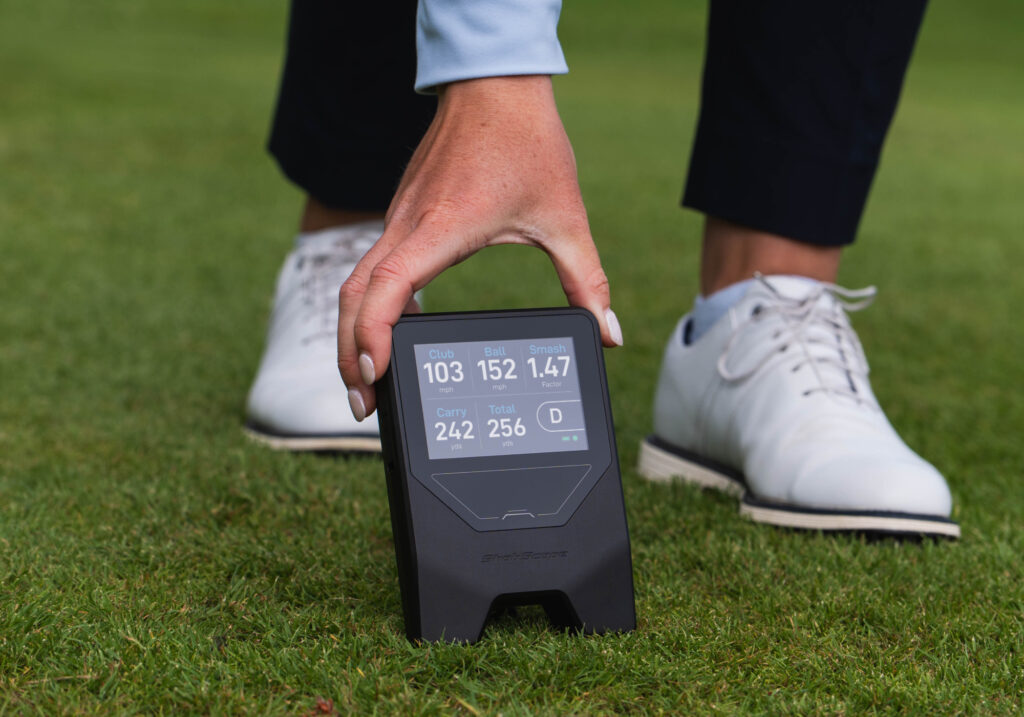
Introducing the Shot Scope 6.
Shot Scope performance tracking technology collects over 100 tour level statistics, including Strokes Gained, allowing you to dive into the data behind your game. For some, this can be overwhelming, which is why we have released the Shot Scope 6: six key statistics to track for lower scores.
Once you have uploaded and edited a round, the Shot Scope 6 will be available to analyse within the app or web dashboard. You can set your scoring target (break 90, 80, etc.), see which of the 6 you achieved, and which ones you didn’t for your round in relation to your target.
Below, we look at each stat in the Shot Scope 6 and how often they happen for a range of scoring milestones, starting with tee shots.
Driver Distance (P-Avg.)
Shot Scope’s Performance-Average metric removes extreme outliers from the dataset to give you a distance that a well-struck shot will travel, and the results are conclusive – longer drives = lower scores.
Driver Distance (P-Avg.)
| Score in the | 100s | 90s | 80s | 70s | 60s |
| Driver P-Avg | 204 yds | 225 yds | 236 yds | 261 yds | 285 yds |
As we move through the scoring milestones, we see players routinely hitting the ball further. It is unlikely you will gain an extra 10-20yds overnight, but through speed training (available on the LM1 Launch Monitor), professional tuition, or optimised equipment, it is possible to gain distance.
By adding this distance, you will have shorter second shots with less club in hand, and as a result, have a greater chance of hitting the green.
Troublesome Tee Shots
The saying goes ‘drive for show, putt for dough,’ but if you are playing three off the tee routinely, then there is little dough to be had.
We define a troublesome tee shot as one that results in a lost ball, is hit into a hazard/trees or requires a positional shot. Shot Scope data reveals a huge divide between low and high handicappers off the tee.
Tee Shots in Trouble
| Score in the | 100s | 90s | 80s | 70s | 60s |
| No. per round | 6.5 | 4.9 | 3.3 | 2 | 0.9 |
A golfer who routinely scores in the 100s has 3x the number of troublesome tee shots as a player who typically scores in the 70s. Reducing costly misses off the tee is essential for golfers looking to lower their scores.
Greens in Regulation (GIR)
One of the more ‘traditional’ statistics to track on your game, but one that truly encapsulates performance, is greens in regulation. A GIR is when a player hits the green in one shot on a par 3, two on a par 4, and three on a par 5.
There is a direct correlation between lower scores and the number of greens you hit, and this is highlighted in the Shot Scope 6.
Greens in Regulation
| Score in the | 100s | 90s | 80s | 70s | 60s |
| GIRs per round | 1.8 | 3.6 | 5.4 | 9 | 10.8 |
As average score decreases, the number of greens in regulation that players hit increases, with the largest jump from one scoring milestone to the next being from 80s to 70s. Golfers who typically score in the 70s hit nearly twice as many greens as those scoring in the 80s.
Multiple Chips within 50yds
We have all seen it on the course, whether it be our playing partners or ourselves, a pitch/chip shot from inside 50yds that misses the green entirely. There are few things more frustrating than duffing a wedge at this distance, but it is, unfortunately, more common than some may think.
Many have visions of hitting a shot that nestles next to the pin, but the reality can be somewhat different, as we see in the data below:
Multiple Chips within 50yds
| Score in the | 100s | 90s | 80s | 70s | 60s |
| No. per round | 4.1 | 3.2 | 2.1 | 1.2 | 0.9 |
Regardless of where you fall in the scoring milestones above, for the vast majority of players, one fewer instance where multiple chips are needed to hit the green inside 50yds will help them move toward the next milestone.
It sounds simple, and it is, but ensuring you hit the green from inside 50yds with your first shot is crucial to lowering your scores – and your blood pressure!
Three Putts
The ultimate momentum killer, the dreaded three putt, is an ever present aspect of the game, and whether you are routinely shooting under par or over, every player is susceptible to them.
Three Putts per Round
| Score in the | 100s | 90s | 80s | 70s | 60s |
| No. per round | 3.2 | 2.3 | 1.5 | 0.9 | 0.5 |
Whilst eradicating them from your game entirely is almost impossible, the Shot Scope 6 reveals that lower scores do not require enormous improvements on the green. Instead, if you are on the cusp of breaking 100 and want to shoot in the 90s, one fewer three putt per round is an essential component.
Missed Putts within 5ft
Putting proficiency inside 5ft can be the difference between a par save or a bogey, or worse. It goes without saying that the closer you leave your first putt to the hole, the easier the second one will be.
Missed Putts within 5ft
| Score in the | 100s | 90s | 80s | 70s | 60s |
| Missed per round | 4.6 | 3.6 | 2.7 | 1.9 | 1.6 |
Again, we see that going from shooting in the 100s to the 90s or from the 90s to the 80s does not require a vast improvement. Instead, one fewer missed putt from short range per round, in addition to the other stats mentioned above, can transform your score.
On the greens, you need to develop a combination of distance control and confidence from short range. Once you have both, you will have fewer three putts and place less pressure on the rest of your game.
Your Benchmarks for Better Golf
The Shot Scope 6 gives you a framework for success. You can easily monitor these benchmarks within the Shot Scope mobile app and web dashboard.
Noticed it was GIR that held you back, dive into your approach play data to get the full picture on where you went wrong.
Whether it be off the tee, into greens, or on them, through performance tracking, you will understand the strengths and weaknesses of your game and know the exact areas to target when practicing to make the biggest improvements on course.
Shot Scope users enjoy, on average, a 4.1 shot improvement in scoring, and the best part is that they don’t have to pay a subscription fee to access any of the features or data.
Download your free copy of the Shot Scope 6 eBook here.
Play better, score lower, and know your game with Shot Scope.